April 9, 2012

Injuries Reported to the TCFP Injury Reporting Program in 2011

2011 was a very successful first FULL year of injury reporting.  A big part of the injury reporting mandate comes from the need to analyze historical injury data and identify trends surrounding these injuries.  By gathering accurate and timely information on firefighter injuries, the Commission will be able to assist departments by disseminating facts concerning these trends, hopefully helping them make changes that will lead to fewer injuries.  Remember – injury reporting is non-punitive.  There are no hidden agendas in the program.  Departments are asked not to report the firefighters name or personal information.  This layer of anonymity allows local control of internal issues and keeps the reporting process altruistic in nature.  The overall safety of the Texas fire service is the only goal!

The 2011 Injury Reporting Program year-end report was presented to the Fire Fighter Advisory Committee on March 8, 2012.  After they review the trends we saw, they will present their recommendations to the Commission for input and approval.  The final report will be out later this year. 

Thank You!
We had a lot of participation in the injury reporting program this year.  We want to thank all those departments who reported injuries and near-miss reports to us.  We also want to thank those who participated in the user focus groups we held, as well as everyone else who provided feedback to us throughout the year.  We implemented some of the requested changes and received some great ideas about to how to improve the program in the future.  We look forward to seeing the program grow and look forward to providing quality information back out to the community. 

Highlights from This Year’s Preliminary Report
A total of 4,180 injuries were reported to us during 2011.  As you can see, these injuries occurred most often during Fire Suppression and Rescue-Non Fire activities.  Sprains & Strains and Environmental Injuries were the most common types of injuries reported.  The Back/Neck and Legs/Knees/Ankles were the most commonly injured body parts. 

Severity of Injuries by Activity 2011 - click to enlarge

Types of Injuries 2011 - click to enlarge

Injuries by Body Location 2011 - click to enlarge


Injuries with Lost Time
Types of Injuries Leading to Lost Time 2011 - click to enlarge
Throughout 2011 we got requests from the fire service for information on lost time in relation to injuries.  Of the 4,180 injuries reported in 2011, 18% of the injuries resulted in missed days.  The commission defines missed work as “lost time” when an individual misses more than one full duty period as a direct result of an injury and does not return to the duties to which they were assigned prior to the injury.  

 The areas included in the “other” category are: broken spine-neck, debris/penetrating, electrocution, exposure airborne pathogen, exposure chemical, smoke and smoke-gas inhalation, and stroke.

Sprain & Strain Injuries
As you can see above, Sprains & Strains lead to the most missed time.  And as you can see below,  Rescue Non-Fire activities were the most common activities leading to Sprains & Strains.   

Activities Leading to Sprains & Strains 2011 - click to enlarge

Stay Tuned
The lost time mentioned above, and many other factors surrounding injuries, can cost your department a great deal of money.  Over the next few months this blog will focus on these issues and we’d love to get your feedback surrounding the data we’ve provided, the costs of injuries, and the effects of injuries on the fire service as a whole. 

March 29, 2012

Thanks to Injury Reporting Departments

One of the Texas Commission on Fire Protection’s most important roles is to help improve the safety of Texas fire fighters. As you know, with your help, our Fire Fighter Injury Reporting system has been collecting valuable information about the injuries Texas fire fighters are incurring.  Through this system, we’re also following up with departments that have “Near Misses” to learn what went right and wrong at these occurrences.  

Taking seriously our mission to improve the safety of Texas fire fighters, the commission has developed an injury investigation reporting document to help investigate “Near Misses.” By making this form available to the fire service, and providing technical assistance when necessary, we hope to help everyone learn from these events. The intent of the project is to facilitate a complete and unbiased review of all aspects of an event, including:
  • The department’s role (for example, department standard operating procedures).
  • Personnel functions and the level of performance and proficiency.
  • Personnel training.
  • Equipment deployed and its performance.
  • Command structure during the event.
As we’ve discussed in past blog posts, to succeed, these reviews must explore both strengths and weaknesses found at the event. The goal of the review is to gain a better understanding of the occurrence and to learn what steps might be necessary to prevent such events from occurring in the future. 

Kudos to Departments Performing “Near Miss” Investigations
The commission would like to recognize a few departments that, true to their mission and members, took the difficult and sometimes uncomfortable steps to change their culture by evaluating “near miss” events, thus fostering a safety culture within their departments: 
  • On June 5, 2011, the Wichita Falls Fire Department had a structure fire in an attached garage.  Two of their fire fighters received burns.
  • On June 17, 2011, the Flower Mound Fire Department had a structure fire in a two story residential home.  Two of their fire fighters received burns.
  • On September 5, 2011, Hutto Fire Rescue had a structure fire in a residential structure with an attached garage.  Two of their fire fighters received burns.
Kudos to Departments Reporting Quality Information to Our Injury Reporting System
The commission would also like to recognize the entities that are actively participating in the Fire Fighter Injury Reporting program. The high quality of information that departments are providing is contributing to our knowledge base. This helps us to provide solid recommendations and up-to-date information about what is happening throughout the state. Our bigger departments, including San Antonio, Dallas, Houston, El Paso and Corpus Christi, have been particularly active. We would like to thank all the reporting departments and their chiefs for encouraging and participating in the program. 

Thank you to everyone who has contributed to our initiatives, thus far! 
Please contact our Injury Reporting Staff if you have any questions about these initiatives.

March 26, 2012

Wellness/Fitness - Exercise Properly

Last week we discussed the fact that exercise, and Wellness/Fitness programs, can in fact lead to firefighter injuries instead of keeping firefighters safe.  You might be wondering, “Can we afford to exercise, given the injury rates related to it?”  Of course, we all know that exercise is a must so that you can be prepared to fight the battles you fight at work, whether you are lifting patients onto gurneys, or bringing a heavy hose to a fire.  We all know this, and while exercising does have its own hazards, it’s still really important.  Obesity rates for firefighters are higher than the public.  This seems wrong, doesn’t it?  You should be the fittest members of our society.  The public is relying on you.  So, be sure and exercise, but do it safely.

Strains and Sprains were reportedly the most common types of injuries that occurred during Wellness/Fitness activities.   In September this blog focused on avoiding strains and sprains (and any injuries at all!) while exercising.  Revisit it today!  Also, keep in mind that stretching regularly helps you avoid injury while getting fit (and in your everyday life).


How often do you work out?

Do you use a spotter when you weight train?

Do you think you’re in good shape?  Be honest.

March 15, 2012

Wellness/Fitness - Exercise Can be Dangerous

Last week we showed you the number and types of reported injuries occurring during Wellness/Fitness activities.  You’re not alone.  In fact, a recent study done by the University of Arizona found that exercise (along with patient transport and training drills – not fire suppression) causes the majority of firefighter injuries in Tucson.  This study is an eye-opener for some, but not us. 

While Wellness/Fitness programs are meant to prepare your body for work, and hopefully help you incur fewer injuries on the job, they sometimes lead directly to injury.  This seems counterintuitive, but if exercise is done incorrectly, it can be harmful.  For instance, keeping your core strong is paramount in getting your body ready to do your job (for instance, lifting patients), but you’ve got to train this area properly to avoid harm.  Check out this video to see how to strengthen your core without hurting your back.

Some believe that fighting a fire can require as much fitness and energy as playing a football game can, so you need to be healthy in all areas of your life.   But exercising properly, and with caution, is important.  Next week we’ll take a look at how you can do just that. 

Have you injured yourself while working out?

Do you know anyone who has hurt themselves working out?

March 9, 2012

Injuries Occurring During Wellness/Fitness Activities

Everyone knows that you’ve got to stay healthy to do your jobs, and that your departments’ Wellness/Fitness programs help you do this.  The TCFP even requires your departments have an SOP for these programs.  And, Courage to be Safe’s Initiative #6:  Medical and Physical Fitness also places great emphasis on these types of programs.  Unfortunately, we’ve had a number of injuries occurring during Wellness/Fitness activities reported to us. 

Injuries occurring during Wellness/Fitness activities are the 5th most common types of injuries reported to our FIDO system.  As you can see below, the body parts being injured during these activities are most commonly knees, backs, ankles and shoulders.  Strains &Sprains are the most common types of injuries occurring during Wellness/Fitness activities.

Wellness/Fitness injuries by body part injured - click to enlarge
Wellness/Fitness injuries by type - click to enlarge


The good news is that 68% of these injuries are minor, which means that the injured firefighters are missing less than one full duty period.  31%, though, are serious and have lost more time at work. 


Check out some examples of injuries occurring during Wellness/Fitness activities:
“While working out the firefighter slipped on the treadmill and sustained abrasions on the knees and right ankle.”
“After playing basketball for about an hour, the firefighter had some pain in low back that still was there the next morning.”
“Firefighter was exercising on treadmill when he experienced chest pains.”
“Firefighter was working out with weights at station and injured right shoulder.”
“During physical fitness, member was crushed finger between dumbbell weight and storage rack.”
“Employee was playing basketball as part of fitness when he fractured right ankle.”


In the coming month, we’ll focus our blog posts on how exercising can be harmful, and how you can exercise for health without injury.  Stay tuned here to learn more.


February 29, 2012

Station Duties Injuries & Lost Time

In our last blog entry we presented information on how many injuries were occurring during Station Duties.  This week we’re going to take a look how these injuries lead to lost time within your departments.

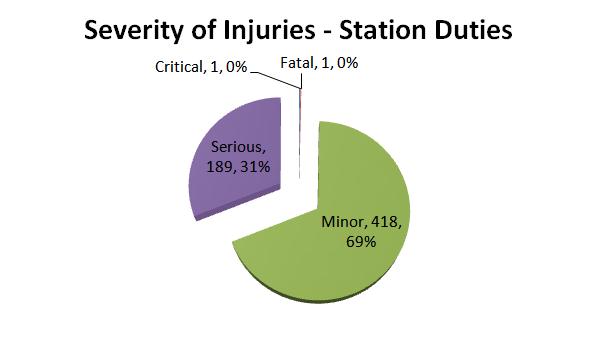
Check out the severity of the Station Duties injuries reported between Jan. 31, 2011 and Jan. 31, 2012:

Severity of Injuries - Station Duties - click to enlarge
69 percent of the reported injuries were minor. Departments did not lose employee time when these occurred.  The remaining 32 percent of the reported injuries were more serious and cost the reporting departments a great deal in wages (ex: OT), productivity losses, medical expenses, and administrative expenses.


Check out the number of departments affected by lost time injuries:


# of  days missed
1-30
31-90
90+
Not yet returned to work
# of departments affected
115
29
15
30


While the majority of the departments have their employees returning to full duties within 30 days, there are still a significant number of departments with additional lost work time.  Looking at these numbers, you can see that there are many avoidable injuries occurring during station duties, and that they can cost departments a great deal of lost time.  Emphasizing the importance of being mindful, careful, and taking your time during your station duties – and avoiding injuries in the process - is an easy way to save money for your department. 

Need more information on the cost of injuries?
Our blog posts in April will focus on more details surrounding the cost of all injuries, and how you can use the trends we see to determine how injuries can affect your budget.  Until then, if you have any questions regarding our lost time data, or would like any other information on these topics, please contact our Injury Reporting staff directly.
 
Do you know how many days of work your employees are missing due to injury?

Have you considered how this is impacting your budget?

Is this information that your ESD Board or City Council would find interesting in order to help you with your budget?

February 13, 2012

Station Duties Leading to Injuries

Station Duties are the third most common activities leading to the firefighter injuries you are reporting to us.  The injuries run the gamut from slips and falls, to stepping in potholes, to running into doors, to picking up and moving equipment and household items, to fighting with hydrants, to raising and lowering ladders, and to stepping on and off apparatus.   

Injuries by Activity - Station Duties - click to enlarge


The top 6 body parts being injured during Station Duties are hands and fingers, backs, knees, shoulders, ankles, and multiple body parts.  

Top 6 Body Parts Injured - Station Duties - click to enlarge

The types of injuries occurring during Station Duties vary, but as you can see, strains/ sprains are the most common.  These injuries are followed most frequently by contusions/bruises and cuts/lacerations.

Top 10 Injury Type - Station Duties - click to enlarge

Check out some examples of the injuries you’ve reported that have occurred during Station Duties:

Injury
Body Part
Injury Descriptions
Contusion/bruise, minor trauma
Foot and toes
Firefighter was injured when a plug cap slipped out of coworker's hand and fell and hit employee, during fire hydrant maintenance.
Contusion/bruise, minor trauma
Multiple body parts, upper body
While checking equipment at shift change and exiting the apparatus, employee lost balance falling off step.
Cut or laceration
Hand and fingers
Firefighter reports that during equipment check at the fire station he opened the fire engine compartment door and an axe fell out striking/lacerating his left little finger.
Cut or laceration
Head, other
Employee stated while on duty at station, he was struck in the forehead by a falling machine causing laceration to head.
Cut or laceration
Wrist
While placing a cutting board and filet knife in the sink the firefighter accidentally stabbed himself in the right wrist. Knife went in approx 3/4 - 1".  Went to doctor for treatment.
Strain-sprain
Ankle
While walking around the truck, firefighter stepped off the sidewalk and rolled the right ankle.  Firefighter was connecting fire hose to truck during testing of pump operations.
Strain-Sprain
Arm, lower, not including elbow or wrist
The firefighter was pulling an extension ladder out of its cradle on a ladder truck when he felt a pull in his right forearm.  The pain has worsened over the last week.
Strain-Sprain
Back, except spine
Obtained a muscle strain to his lower back while moving an extrication power unit from one apparatus to another.  Was using improper carrying techniques to prevent getting his uniform dirty.  No pain noted at the time, but severe back pain appeared within 24 hrs.
Strain-sprain
Shoulder
Fire Fighter was doing morning equipment check at time of injury. The Fire Fighter attempted to pull start the hydraulic power unit for the rescue tools when the engine kicked back and strained his shoulder.

How can you avoid these injuries?

First, be careful.  When you’re at the station, unlike when you’re on the fire ground, you are not necessarily in a hurry.  Be sure to slow down and perform your duties carefully and thoughtfully.  Last September our blog posts focused on Strains & Sprains.  Revisit those posts for tips about how to avoid these very common types of injuries. 


Next week we’ll focus the blog post on the ways these seemingly avoidable injuries affect your department’s bottom line – lost time, in particular.  Lost time can get costly quickly, so check back here for details next week!


Do you see a lot of injuries occurring during Station Duties?


Have you actually hurt yourself while performing Station Duties?

Can you see any way these injuries could have been avoided?