Showing posts with label contustions. Show all posts

February 13, 2012

Station Duties Leading to Injuries

Station Duties are the third most common activities leading to the firefighter injuries you are reporting to us.  The injuries run the gamut from slips and falls, to stepping in potholes, to running into doors, to picking up and moving equipment and household items, to fighting with hydrants, to raising and lowering ladders, and to stepping on and off apparatus.   

Injuries by Activity - Station Duties - click to enlarge


The top 6 body parts being injured during Station Duties are hands and fingers, backs, knees, shoulders, ankles, and multiple body parts.  

Top 6 Body Parts Injured - Station Duties - click to enlarge

The types of injuries occurring during Station Duties vary, but as you can see, strains/ sprains are the most common.  These injuries are followed most frequently by contusions/bruises and cuts/lacerations.

Top 10 Injury Type - Station Duties - click to enlarge

Check out some examples of the injuries you’ve reported that have occurred during Station Duties:

Injury
Body Part
Injury Descriptions
Contusion/bruise, minor trauma
Foot and toes
Firefighter was injured when a plug cap slipped out of coworker's hand and fell and hit employee, during fire hydrant maintenance.
Contusion/bruise, minor trauma
Multiple body parts, upper body
While checking equipment at shift change and exiting the apparatus, employee lost balance falling off step.
Cut or laceration
Hand and fingers
Firefighter reports that during equipment check at the fire station he opened the fire engine compartment door and an axe fell out striking/lacerating his left little finger.
Cut or laceration
Head, other
Employee stated while on duty at station, he was struck in the forehead by a falling machine causing laceration to head.
Cut or laceration
Wrist
While placing a cutting board and filet knife in the sink the firefighter accidentally stabbed himself in the right wrist. Knife went in approx 3/4 - 1".  Went to doctor for treatment.
Strain-sprain
Ankle
While walking around the truck, firefighter stepped off the sidewalk and rolled the right ankle.  Firefighter was connecting fire hose to truck during testing of pump operations.
Strain-Sprain
Arm, lower, not including elbow or wrist
The firefighter was pulling an extension ladder out of its cradle on a ladder truck when he felt a pull in his right forearm.  The pain has worsened over the last week.
Strain-Sprain
Back, except spine
Obtained a muscle strain to his lower back while moving an extrication power unit from one apparatus to another.  Was using improper carrying techniques to prevent getting his uniform dirty.  No pain noted at the time, but severe back pain appeared within 24 hrs.
Strain-sprain
Shoulder
Fire Fighter was doing morning equipment check at time of injury. The Fire Fighter attempted to pull start the hydraulic power unit for the rescue tools when the engine kicked back and strained his shoulder.

How can you avoid these injuries?

First, be careful.  When you’re at the station, unlike when you’re on the fire ground, you are not necessarily in a hurry.  Be sure to slow down and perform your duties carefully and thoughtfully.  Last September our blog posts focused on Strains & Sprains.  Revisit those posts for tips about how to avoid these very common types of injuries. 


Next week we’ll focus the blog post on the ways these seemingly avoidable injuries affect your department’s bottom line – lost time, in particular.  Lost time can get costly quickly, so check back here for details next week!


Do you see a lot of injuries occurring during Station Duties?


Have you actually hurt yourself while performing Station Duties?

Can you see any way these injuries could have been avoided?


January 12, 2012

Wounds


A wound, as defined by Webster’s New World Stedman’s Concise Medical Dictionary,
is “a trauma to any of the tissues of the body especially that caused by physical means and with interruption of continuity.”

Take a look at the wound injuries your departments have been reporting. 

The majority of these have occurred during the following four activities: Fire Suppression; Station Duties; Rescue Non-Fire Activities; and Skills Training. 

Wounds by Activity - click to enlarge

 
Within those categories, the most frequent injury types are cuts/lacerations and minor trauma contusions/bruises.  These types of wounds make up 80 percent of the wounds reported.

Wounds by Type - click to enlarge


The hands and fingers far outnumber any other body part with wound injuries - with 229 injuries. 

Wounds by Body Part - click to enlarge


Wounds occurring during Station Duties
The commission has defined Station Duties, for injury reporting purposes, as “Any activity done around the station, not an emergency response activity.”   Examples include checking apparatus, moving apparatus, checking hydrants, or maintaining the station (mowing, cleaning bays, house-keeping, etc.).

Station Duties - Wounds - click to enlarg
Check out some examples of Wounds occurring during Station Duties:
“Blade hit leg while attempting to start vent saw. The saw was not running at the time.”
Employee reports that while at the fire station he lacerated his right hand while sharpening a kitchen knife used for preparing meals.”

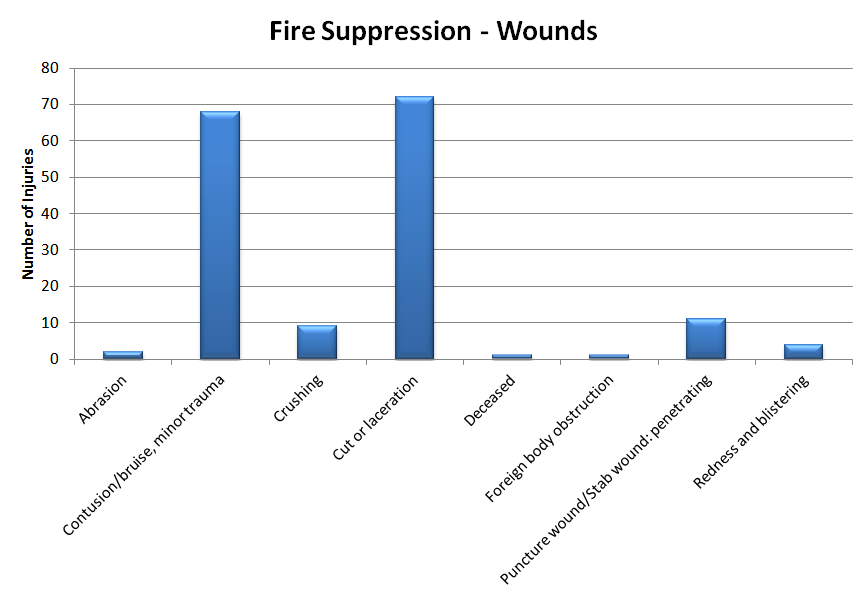
Wounds occurring during Fire Suppression
Fire Suppression - Wounds - click to enlarge

Check out some examples of wounds occurring during Fire Suppression:
“Employee stated that while on location right hand was punctured pulling a wall down - a nail went through a glove sustaining injury.” 
“Firefighter was dragging a charged hose line through a burning structure and tripped over contents - bruising his shins on both legs.” 
“While cutting a fire break line, using hand tools, firefighter struck self with pulaski - not breaking the skin - causing localized swelling the size of a gold ball.  Firefighter didn't have a current tetanus shot and was transported to local hospital.”

Wounds occurring during other activities
Check out some examples of wounds occurring during Rescue – Non-Fire Activities:
“Firefighter lacerated left middle finger while working at a motor vehicle accident.”
“Employee was providing medical treatment when he was punctured by needle stick on left thumb.”
“Firefighter received injury while removing patient who was covered in broken glass at a MVA.”

Check out some examples of wounds occurring during Skills Training:
“Employee was doing extrication training.  Another employee swung an axe & it made contact with the halligan that the first employee was holding, hitting his left index finger.”
“Firefighter was doing training with a metal snap tank when a loose piece of metal sliced through his finger causing an approximately 1.5 inch cut.”

 Wounds can be avoided
On the fire ground, things are hectic and can easily go wrong.  If your team trains with department safety SOPs in mind, you’ll be safer on scene.  Using proper PPE for various situations will also help protect you from wound injuries.  In the station, and in non-emergency situations, take the time to do things right and use the proper tools for the job.  You can avoid wound injuries on the job, in any situation.

Quick tips for avoiding wound injuries:
  •  Wear the proper PPE for the proper job. 
  •  Follow the instructions on any equipment. 
  •  Take your time, when not in an emergency situation. 
  •  Train safely, so that it becomes habit in the field.


In the coming weeks, we’ll be discussing two types of wound injuries reported to us – wounds that could have been avoided had the injured party been wearing the proper (or any!) gloves, and wounds that likely occurred because department SOPs were not followed at the time of injury.