February 29, 2012

Station Duties Injuries & Lost Time

In our last blog entry we presented information on how many injuries were occurring during Station Duties.  This week we’re going to take a look how these injuries lead to lost time within your departments.

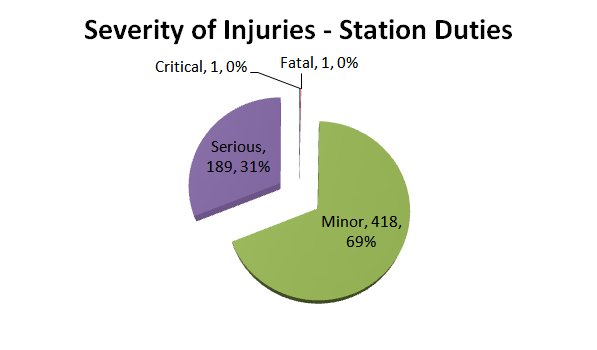
Check out the severity of the Station Duties injuries reported between Jan. 31, 2011 and Jan. 31, 2012:

Severity of Injuries - Station Duties - click to enlarge
69 percent of the reported injuries were minor. Departments did not lose employee time when these occurred.  The remaining 32 percent of the reported injuries were more serious and cost the reporting departments a great deal in wages (ex: OT), productivity losses, medical expenses, and administrative expenses.


Check out the number of departments affected by lost time injuries:


# of  days missed
1-30
31-90
90+
Not yet returned to work
# of departments affected
115
29
15
30


While the majority of the departments have their employees returning to full duties within 30 days, there are still a significant number of departments with additional lost work time.  Looking at these numbers, you can see that there are many avoidable injuries occurring during station duties, and that they can cost departments a great deal of lost time.  Emphasizing the importance of being mindful, careful, and taking your time during your station duties – and avoiding injuries in the process - is an easy way to save money for your department. 

Need more information on the cost of injuries?
Our blog posts in April will focus on more details surrounding the cost of all injuries, and how you can use the trends we see to determine how injuries can affect your budget.  Until then, if you have any questions regarding our lost time data, or would like any other information on these topics, please contact our Injury Reporting staff directly.
 
Do you know how many days of work your employees are missing due to injury?

Have you considered how this is impacting your budget?

Is this information that your ESD Board or City Council would find interesting in order to help you with your budget?

February 13, 2012

Station Duties Leading to Injuries

Station Duties are the third most common activities leading to the firefighter injuries you are reporting to us.  The injuries run the gamut from slips and falls, to stepping in potholes, to running into doors, to picking up and moving equipment and household items, to fighting with hydrants, to raising and lowering ladders, and to stepping on and off apparatus.   

Injuries by Activity - Station Duties - click to enlarge


The top 6 body parts being injured during Station Duties are hands and fingers, backs, knees, shoulders, ankles, and multiple body parts.  

Top 6 Body Parts Injured - Station Duties - click to enlarge

The types of injuries occurring during Station Duties vary, but as you can see, strains/ sprains are the most common.  These injuries are followed most frequently by contusions/bruises and cuts/lacerations.

Top 10 Injury Type - Station Duties - click to enlarge

Check out some examples of the injuries you’ve reported that have occurred during Station Duties:

Injury
Body Part
Injury Descriptions
Contusion/bruise, minor trauma
Foot and toes
Firefighter was injured when a plug cap slipped out of coworker's hand and fell and hit employee, during fire hydrant maintenance.
Contusion/bruise, minor trauma
Multiple body parts, upper body
While checking equipment at shift change and exiting the apparatus, employee lost balance falling off step.
Cut or laceration
Hand and fingers
Firefighter reports that during equipment check at the fire station he opened the fire engine compartment door and an axe fell out striking/lacerating his left little finger.
Cut or laceration
Head, other
Employee stated while on duty at station, he was struck in the forehead by a falling machine causing laceration to head.
Cut or laceration
Wrist
While placing a cutting board and filet knife in the sink the firefighter accidentally stabbed himself in the right wrist. Knife went in approx 3/4 - 1".  Went to doctor for treatment.
Strain-sprain
Ankle
While walking around the truck, firefighter stepped off the sidewalk and rolled the right ankle.  Firefighter was connecting fire hose to truck during testing of pump operations.
Strain-Sprain
Arm, lower, not including elbow or wrist
The firefighter was pulling an extension ladder out of its cradle on a ladder truck when he felt a pull in his right forearm.  The pain has worsened over the last week.
Strain-Sprain
Back, except spine
Obtained a muscle strain to his lower back while moving an extrication power unit from one apparatus to another.  Was using improper carrying techniques to prevent getting his uniform dirty.  No pain noted at the time, but severe back pain appeared within 24 hrs.
Strain-sprain
Shoulder
Fire Fighter was doing morning equipment check at time of injury. The Fire Fighter attempted to pull start the hydraulic power unit for the rescue tools when the engine kicked back and strained his shoulder.

How can you avoid these injuries?

First, be careful.  When you’re at the station, unlike when you’re on the fire ground, you are not necessarily in a hurry.  Be sure to slow down and perform your duties carefully and thoughtfully.  Last September our blog posts focused on Strains & Sprains.  Revisit those posts for tips about how to avoid these very common types of injuries. 


Next week we’ll focus the blog post on the ways these seemingly avoidable injuries affect your department’s bottom line – lost time, in particular.  Lost time can get costly quickly, so check back here for details next week!


Do you see a lot of injuries occurring during Station Duties?


Have you actually hurt yourself while performing Station Duties?

Can you see any way these injuries could have been avoided?


January 26, 2012

Wounds Occurring When Not Following SOPs

Last week we discussed wounds occurring when not wearing gloves.  Not wearing gloves, and other PPE for that matter, is often a violation of departmental Standard Operating Procedures (SOPs).  Many reported injuries could have been avoided had the injured party followed their department’s SOPs.   This week we’ll focus our blog post on the importance of SOPs and how you can decrease injuries by making sure you and your team follow them on every call.


SOP Issues
The commission requires every regulated entity to adopt several SOPs. These SOPs are required to ensure the safety of all fire fighters. Unfortunately, we have seen a few areas where firefighters were not following these SOPs.  Incorporating SOPs into training is a good way to build habits leading to safer behavior on the fire ground.

In 2011, among the injuries reported, you reported 27 documented SOP violations. The majority of them involve the injured parties not wearing Personal Protective Equipment (PPE) – often missing gloves. 


Check out some examples of Wounds occurring when the injured party was not following departmental SOPs:
“Individual got burned due to not wearing PPE during grass fire.  The department has SOP's regarding wildland fires and PPE that should be used.  The department is addressing this internally.”

“He has PPE's but was not wearing the coat. He was the driver of the pumper and was rolling up the red line and was pulling it over the wire fence.  He does not have wildland PPE's.  He failed to comply as he should have had his coat on.   The department will address internal SOP issues.”


Fight like you train
Do what you can to make sure your department provides quality training experiences, by incorporating department SOPs.  These should realistically reflect situations your team will face.  Similarly, when you are on scene, react the way you were trained to react.  Don’t cut corners in training, or on the scene.  Make sure proper PPE are worn and SOPs are followed during and after training – ALWAYS.  Make it habit, so that when the time comes no one gets injured or finds themselves in a near-miss situation


Write effective SOPs for your department
Learn to write applicable and realistic SOPs and you’ll get higher adherence rates.  Additionally, you’ll have safer firefighters who develop better work habits.  Check out these tips and contact the TCFP Library for other departments’ examples of our required SOPs.

Follow up from last month:  Last month we discussed a near-miss that occurred in Hutto, TX.  Firehouse Magazine’s continued coverage of that incident is in their January issue.  They address the issue of having quality SOPs, and training to them.  If you need a copy of the articles, contact the TCFP Library.


Are your department’s SOPs realistic? 

Do your department’s SOPs play an important part in training?

January 20, 2012

Wounds Due to Not Wearing Gloves

Image courtesy of jasonEscapist via flickr - click to enlarge
Last week we discussed the wounds that fire departments are reporting to us. It seems that many of these wounds could have been avoided had the department’s standard operating procedures (SOPs) for PPE been followed.  This week we’ll focus on injuries incurred when not wearing gloves.
 
“No Gloves” Injuries
Quite a few injuries result when personnel don’t wear gloves when they should. When this occurs in your department, you’ll want to ask yourself, “Why are you taking off or not wearing the gloves?” Is it because gloves interfere with your dexterity, making it difficult to perform the task at hand? Is it habit (and not a good one) that you need to correct? Should the department look into the brand or type of glove the department is using and evaluate them for their effectiveness?

Check out some examples of Wounds occurring when the injured party is not wearing gloves:

“Fire fighter was part of a three-man team that had responded to a private residence for a water flow alarm and smoke investigation. Sprinkler system had extinguished fire in main room. While doing a secondary search for extension, fire fighters discover flame and called for water supply. While refitting equipment, adjacent room flashed causing burns to fire fighter's hands before he could complete putting his gloves back on.”

“Employee was at scene of MVA and attempted to pry tail pipe on muffler away from tire. Hand slipped and received laceration to index, middle and ringer of right hand. Went to hospital ER and received stitches to 2 fingers. He was not wearing fire fighting gloves at the time of injury.”

“During overhaul operations, the firefighter was standing on the base of a "pull-down" attic ladder. He began to climb the ladder to hand tools to a firefighter working in the attic when the ladder broke. As the firefighter was falling, he grabbed the side of the ladder and lacerated his finger. The firefighter was not wearing gloves at the time of injury. The laceration required five stitches.”

At a structure fire, fire fighter was working in an attic space checking fire conditions. He removed his gloves to use the thermal imaging camera when the attic flashed over causing second degree burns to the back of his hands. He was wearing all of his PPE and SCBA except for his gloves. He was transported to the hospital.”

“Firefighter was loading hose tray back on engine and was not wearing gloves. A burr on the metal sliced his right thumb open.”

What is the problem & how can it be fixed?
You often find yourselves in urgent situations.  These situations can cause you to cut corners.  This is understandable, but doing so puts you in harm’s way.  Additionally, some gloves keep you from being able to perform your duties by limiting dexterity.  Having high-quality gloves and a variety of gloves readily available will ensure that you wear the right gloves for the job and keep yourself safe.  Taking the time to stop, pick the right gloves, and then get on with your job is worthwhile; at least when compared to missing work!

Wear high quality, appropriate, gloves that meet national standards


Does your department provide a variety of gloves to you for a variety of types of jobs?  What’s your favorite type of glove for specific duties?

Is it realistic for you to pick the right gloves, at the right time, to do the job right?

January 12, 2012

Wounds


A wound, as defined by Webster’s New World Stedman’s Concise Medical Dictionary,
is “a trauma to any of the tissues of the body especially that caused by physical means and with interruption of continuity.”

Take a look at the wound injuries your departments have been reporting. 

The majority of these have occurred during the following four activities: Fire Suppression; Station Duties; Rescue Non-Fire Activities; and Skills Training. 

Wounds by Activity - click to enlarge

 
Within those categories, the most frequent injury types are cuts/lacerations and minor trauma contusions/bruises.  These types of wounds make up 80 percent of the wounds reported.

Wounds by Type - click to enlarge


The hands and fingers far outnumber any other body part with wound injuries - with 229 injuries. 

Wounds by Body Part - click to enlarge


Wounds occurring during Station Duties
The commission has defined Station Duties, for injury reporting purposes, as “Any activity done around the station, not an emergency response activity.”   Examples include checking apparatus, moving apparatus, checking hydrants, or maintaining the station (mowing, cleaning bays, house-keeping, etc.).

Station Duties - Wounds - click to enlarg
Check out some examples of Wounds occurring during Station Duties:
“Blade hit leg while attempting to start vent saw. The saw was not running at the time.”
Employee reports that while at the fire station he lacerated his right hand while sharpening a kitchen knife used for preparing meals.”

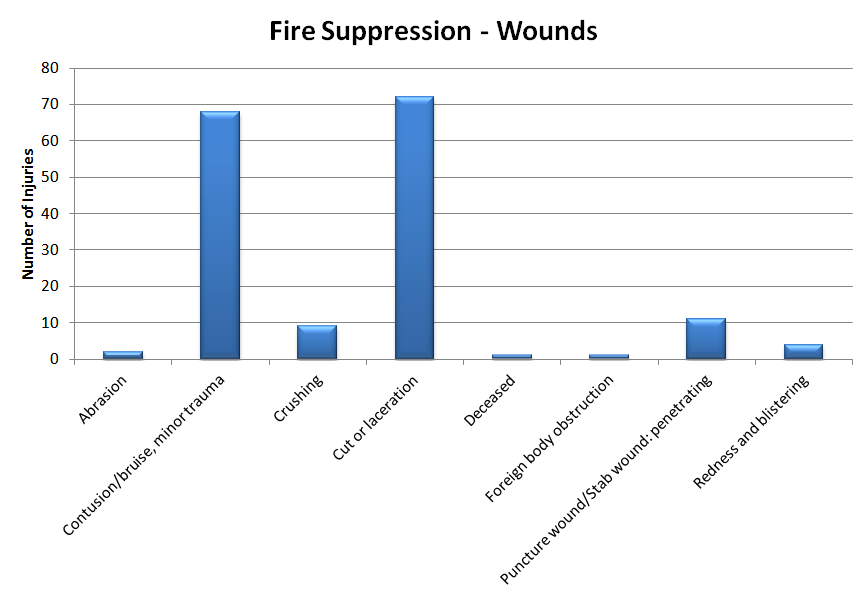
Wounds occurring during Fire Suppression
Fire Suppression - Wounds - click to enlarge

Check out some examples of wounds occurring during Fire Suppression:
“Employee stated that while on location right hand was punctured pulling a wall down - a nail went through a glove sustaining injury.” 
“Firefighter was dragging a charged hose line through a burning structure and tripped over contents - bruising his shins on both legs.” 
“While cutting a fire break line, using hand tools, firefighter struck self with pulaski - not breaking the skin - causing localized swelling the size of a gold ball.  Firefighter didn't have a current tetanus shot and was transported to local hospital.”

Wounds occurring during other activities
Check out some examples of wounds occurring during Rescue – Non-Fire Activities:
“Firefighter lacerated left middle finger while working at a motor vehicle accident.”
“Employee was providing medical treatment when he was punctured by needle stick on left thumb.”
“Firefighter received injury while removing patient who was covered in broken glass at a MVA.”

Check out some examples of wounds occurring during Skills Training:
“Employee was doing extrication training.  Another employee swung an axe & it made contact with the halligan that the first employee was holding, hitting his left index finger.”
“Firefighter was doing training with a metal snap tank when a loose piece of metal sliced through his finger causing an approximately 1.5 inch cut.”

 Wounds can be avoided
On the fire ground, things are hectic and can easily go wrong.  If your team trains with department safety SOPs in mind, you’ll be safer on scene.  Using proper PPE for various situations will also help protect you from wound injuries.  In the station, and in non-emergency situations, take the time to do things right and use the proper tools for the job.  You can avoid wound injuries on the job, in any situation.

Quick tips for avoiding wound injuries:
  •  Wear the proper PPE for the proper job. 
  •  Follow the instructions on any equipment. 
  •  Take your time, when not in an emergency situation. 
  •  Train safely, so that it becomes habit in the field.


In the coming weeks, we’ll be discussing two types of wound injuries reported to us – wounds that could have been avoided had the injured party been wearing the proper (or any!) gloves, and wounds that likely occurred because department SOPs were not followed at the time of injury.


December 20, 2011

Learn From Other Departments’ Post-Incident Analyses and Near-Miss Reports


Image courtesy of  Deepwater Horizon Response on flickr
As we discussed earlier this month, your department may get some pretty interesting calls, but most calls are rather routine.  Regardless, a Post-Incident Analysis after every call can be valuable, especially if an injury is involved.  But, let’s say your department has been pretty quiet lately, or your calls have been routine.  You might need a little excitement to perk the interest of your team and keep them on their toes.  This is when other departments’ Near-Miss Reports and Post-Incident Analyses are valuable. 


Learn from others across the country
To learn from other departments’ experiences, check out the National Fire Fighter Near-Miss Reporting System.  This service has three main goals: 
  1. To give firefighters the opportunity to learn from each other through real-life experiences.
  2. To help formulate strategies to reduce the frequency of firefighter injuries and fatalities.
  3. To enhance the safety culture of the fire and emergency service.

Other online resources

Learn from local departments
Last week we discussed how certain injuries reported to our FIDO Injury Reporting System lead to investigations by our agency.  As we mentioned, most departments will conduct an internal investigation.  Having the reports from these investigations on hand help us complete our investigation quickly.  Contact us if you’d like to see examples of recent investigations done by the below Texas departments.


  • “Northview Court Mayday” Incident Analysis – Structure Fire – Flower Mound Fire Department
  • Firefighter Near-Miss Report – Firefighter Injury - Hutto Fire Rescue*

*The first part in a two-part series regarding the Hutto Fire Rescue incident appears this month in Firehouse magazine.  The second part will be in the January issue.  Check them out to learn more!  If you need a copy of the articles, contact the TCFP Library.

Do you read Near-Miss reports?

Does your department review Near-Miss reports in departmental meetings or training?

Have you ever contributed to the Near-Miss Reporting System?